Buy my-socks.com ?
We are moving the project
my-socks.com .
Are you interested in purchasing the domain
my-socks.com ?
domain@kv-gmbh.de · 0541-91531010
Buy my-socks.com ?
When do you use il faut and il ne faut pas?
"Il faut" is used to express what is necessary or required, while "il ne faut pas" is used to express what is not allowed or should be avoided. For example, you would use "il faut" to say "il faut étudier pour réussir" (it is necessary to study to succeed), and "il ne faut pas" to say "il ne faut pas fumer dans ce lieu" (smoking is not allowed in this place). These expressions are used to give advice, make recommendations, or set rules. **
What is the difference between il faut que and il faut?
"Il faut" is used to express a general necessity or obligation, while "il faut que" is used to introduce a specific action or event that is necessary or required. For example, "il faut manger" means "it is necessary to eat" in a general sense, while "il faut que tu manges" means "you need to eat" in a specific sense. "Il faut" is used to make a general statement about what is necessary, while "il faut que" is used to specify what needs to be done. **


Similar search terms for Bonarda-Vivace-Tenuta-il
Top-Angebote
Products related to Bonarda-Vivace-Tenuta-il:
-
Picchioni Andrea Bonarda vivace 'Ipazia' Picchioni 2024Bonarda Vivace 'Ipazia' is a sparkling red wine characterized by a flowing and spirited beva made by the Lombard winery Andrea Picchioni. We are within the municipality of Canneto Pavese, in Oltrepò Pavese, a triangle of land located on the northern tip of the Apennines. Here, Andrea Picchioni manages ten hectares of certified organic vineyards, dedicated in part to traditional grape varieties such as Croatina, Barbera, Vespolina and Uva Rara, and for the remainder reserved for Pinot Noir, a variety that has found an ideal habitat in Oltrepò Pavese. The name 'Hypatia' recalls the eponymous mathematician, astronomer and philosopher of Ancient Greece, who lived between the fifth and fourth centuries BC. Andrea Picchioni Bonarda Vivace 'Ipazia' is made from only Croatina grapes grown on steep soils of a sandy-clay matrix in the Solinga Valley. The rows, facing full south, are cultivated according to certified organic farming principles. Manual harvesting is followed by the crushing and destemming of the grapes, with subsequent alcoholic fermentation taking place between steel and concrete tanks with 4-5 days of contact between the must and skins. Once this brief period is over, racking takes place, and the mass is then placed in an autoclave with its natural residual sugars for light frothing according to the Charmat Method, thanks only to the intervention of indigenous yeasts. 'Ipazia' Bonarda Vivace di Andrea Picchioni has a bright ruby red colour with distinct violet hues. Intense, vinous nose in its hints of morello cherry, violet, raspberry and black cherry, enriched by pleasant hints of musk. Fresh, light and lively taste, with a lingering fruity aftertaste that invites new tastings.12,00 £*Shipping: 48,00 £Secure redirect to the provider
-
Torti Pietro Bonarda Vivace Pietro Torti 2025The sparkling red wine Bonarda Vivace from the Lombard winery Pietro Torti highlights a pleasant lively and amiable spirit, characteristic of the type. We are among the hills of Montecalvo Versiggia, in the Oltrepò Pavese, where Alessandro Torti has inherited the viticultural legacy of his father Pietro, to whom the estate is named, adopting the same love for the territory and the same passion for the wine world. Although called Bonarda, this wine should not be confused with the homonymous Piedmontese grape variety, as the Bonarda of Oltrepò Pavese is a well-known label based on Croatina, a grape that in this area is commonly referred to as Bonarda. The Bonarda Vivace Pietro Torti is a 100% Croatina from vines rooted in soils mainly composed of silt and clay, at 320 meters above sea level. The vines, managed under certified organic regime, were planted in 1998. Once harvested, the grapes are taken to the winery where they are pressed in steel tanks for alcoholic fermentation, associated with about 12-14 days of maceration on the skins. Also the subsequent short maturation period takes place in steel, at the end of which the mass is bottled with still a slight effervescence. Pietro Torti Bonarda Vivace from Oltrepò Pavese has a ruby red color with violet reflections. The nose offers intense aromas of blueberry, blackberry, and cherry, combined with light perceptions of red flowers on the finish. On the palate, it is lively and smooth, with a pleasant and lively effervescence that supports the freshness balancing the soft and sweet taste. The subtle tannic structure leads to a distinctly fruity finish. Due to its liveliness, this Bonarda is configured as an excellent pairing with assorted cold cuts.14,00 £*Shipping: 48,00 £Secure redirect to the provider
-
Quaquarini Francesco Bonarda vivace Francesco Quaquarini 2025La Bonarda di Francesco Quaquarini è un vino rosso frizzante, sincero nella sua espressione e dai lati femminili che sanno intrigare e rendono piacevole la beva. La Bonarda è una bella rappresentazione dell’Oltrepò Pavese e nasce dalle uve dei vigneti di Croatina, Barbera e Ughetta di Canneto, i quali si estendono in una delle zone più vocate alla coltivazione di uva. Tra i filari si segue un processo produttivo virtuoso che prevede il rispetto del regime biologico e di pratiche tradizionali e sostenibili. I lavori in cantina prevedono lo svolgimento della fermentazione alcolica delle uve in acciaio, la caratteristica effervescenza viene assunta attraverso il processo fermentativo in soluzione che genera l’anidride carbonica. L’affinamento prevede una breve sosta in acciaio. Si presenta con un colore rosso rubino e con schiuma e riflessi accattivanti di colore porpora. I profumi che evoca sono puliti e raffinati: ciliegia, mora selvatica, frutti di bosco. Al palato è morbido e avvolgente, animato da una piacevole effervescenza che lo rende dinamico e beverino, con note balsamiche di lunga persistenza. È una Bonarda versatile, ottimo accompagnamento a tutto pasto, ideale con salumi, insaccati e con i ricchi risotti della Pianura Padana. Si tratta di una Bonarda eccellente, perfetta espressione di un ampio terroir con le sue specificità.10,00 £*Shipping: 48,00 £Secure redirect to the provider
-
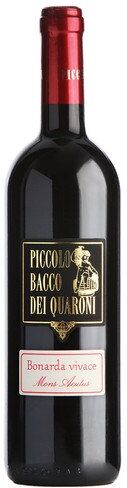
Bonarda vivace 'Mons Acutus' Piccolo Bacco dei Quaroni 2021Il “Mons Acutus” è un vino rosso dove delicatezza, genuinità e schiettezza si uniscono in un tutt’uno, dando vita a una Bonarda vivace frizzante e beverina, ideale da condividere con gli amici di sempre in occasioni informali. Una bottiglia che incarna la filosofia produttiva della cantina Piccolo Bacco dei Quaroni, realtà dell’Oltrepò Pavese il cui proprietario, Mario Cavalli, si distingue per l’impegno volto a riportare la viticoltura in stretto contatto con il territorio; può sembrare paradossale, ma troppo spesso le produzioni delle cantine sono influenzate da logiche di tipo industriale, che finiscono col soggiogare le pratiche artigianali. E’ quindi con immenso piacere che si sorseggia il “Mons Acutus”, vero e proprio alfiere delle sane tradizioni contadine. Questo “Mons Acutus” è una Bonarda vivace che la cantina Piccolo Bacco dei Quaroni realizza in linea con i propri principi, che mirano a proporre una viticoltura sostenibile e rispettosa nell’Oltrepò. Le uve di Croatina, a cui si aggiunge un pizzico di Barbera, vengono coltivate secondo pratiche biologiche, e, dopo la vendemmia, fermentano in acciaio a temperatura controllata grazie all’utilizzo di lieviti indigeni, macerando brevemente ma intensamente. Seguono poi la rifermentazione in autoclave, da cui si ottiene la presa di spuma, e il successivo imbottigliamento. La Bonarda vivace “Mons Acutus” della cantina Piccolo Bacco dei Quaroni si presenta nel bicchiere con un colore rosso rubino intenso, con una spuma frizzante, allegra e vivace. Il bouquet di profumi che avvolge il naso è interamente giocato su note fruttate, leggere e sottili. Al palato è di corpo scorrevole e snello, con un sorso di piacevole freschezza. Questo “Mons Acutus” è il rosso ideale da stappare in momenti di pura convivialità, per portare gioia e felicità in tavola!10,00 £*Shipping: 48,00 £Secure redirect to the provider


-
Why is it souhaite-t-il and not souhaite-s-il?
In French, the pronoun "il" (he) is combined with the verb "souhaiter" (to wish) to form the phrase "souhaite-t-il" because of the rule of verb inversion in interrogative sentences. When forming a question in French, the subject pronoun and the verb are inverted, so "souhaite-t-il" follows this rule. The "t" is added to create a liaison between the verb and the pronoun, making the pronunciation smoother. **
-
How does "il faut" work in French?
"Il faut" is a common expression in French that is used to convey the idea of necessity or obligation. It is followed by an infinitive verb and is used to express what needs to be done or what is necessary in a given situation. For example, "Il faut manger" means "It is necessary to eat." This expression is used to give advice, make suggestions, or express general truths. **
-
What is an El, Sl, and Il?
An El, Sl, and Il are all suffixes used in the English language to form adjectives. "El" is used to form adjectives that mean "pertaining to" or "characterized by," such as in the word "musical." "Sl" is used to form adjectives that mean "tending to" or "inclined to," such as in the word "careful." "Il" is used to form adjectives that mean "having the nature of" or "capable of," such as in the word "flexible." These suffixes help to create new adjectives by modifying the meaning of the base word. **
-
What comes after il faudrait in French?
In French, "il faudrait" is followed by the infinitive form of a verb. This construction is used to express a suggestion or a polite request. For example, "il faudrait partir tôt" means "it would be necessary to leave early." **


Since when have sneaker socks been in fashion?
Sneaker socks have been in fashion since the late 2000s, gaining popularity as a stylish and practical option for wearing with sneakers and low-cut shoes. They are designed to be low-profile and invisible when worn with shoes, making them a popular choice for those who want the comfort of socks without the bulkiness. Sneaker socks have become a staple in many people's wardrobes, especially during the warmer months when wearing sandals or low-cut shoes. **
Which words contain an il in the middle?
Some words that contain "il" in the middle are: civil, child, mild, wild, and similar. These words have the letter combination "il" in the middle of the word. **
Top-Angebote
Products related to Bonarda-Vivace-Tenuta-il:
-
Bonarda Vivace Tenuta il Bosco 2025The Bonarda Vivace Tenuta il Bosco is a product that tells the story of the territorial enhancement carried out by the winery. It starts with a typical grape from the Pavese area, the Croatina, to create a fragrant label that engages the nose and palate with a sequence of fruity flavors and aromas, simple and direct. A slightly “pétillant” bottle that, precisely because of this characteristic, invites a frequent sip, demonstrating the excellent work done by the Tenuta il Bosco team. Among its many qualities, it is also a true wild card at the table, perfect for brightening up the most convivial evenings spent with friends. The Bonarda Vivace signed by Tenuta il Bosco is made from pure Croatina grapes, grown in the vineyards of Zenevredo, in the Oltrepò Pavese. The bunches are carefully selected during the manual harvest phase and are immediately transferred to the winery's vinification facilities. Here, after destemming, which involves further qualitative selection of the grapes, the berries are gently pressed, and the resulting must ferments for the first time in stainless steel containers, then re-ferments in autoclave, following the principles that govern the production of the Martinotti Method. This Bonarda Vivace Tenuta il Bosco presents itself visually with a ruby color, characterized by some more violet streaks. In the glass, the wine appears slightly “cloudy”. The fruit is the protagonist on the nose, then giving way to background notes centered on the aromas of freshly wilted flowers. On the palate, it is medium-bodied, with a straightforward and drinkable sip, characterized by a slightly sweet taste. A perfect label to uncork now, perhaps at aperitif time paired with a nice platter of mixed cured meats and cheeses.8,00 £*Shipping: 48,00 £Secure redirect to the provider
-
Bonarda Vivace 'La Brughera' Giorgi 2025“La Brughera” è una Bonarda vivace, che, sin da subito, mette in luce la propria peculiarità, ovvero quella di presentarsi con un sorso frizzante al palato, decisamente beverino. Si tratta di un vino lombardo dal profilo semplice, che al naso presenta note principalmente fruttate. La struttura genuina e pura di quest’etichetta firmata dalla cantina Giorgi, fa anche sì che questa abbia un ruolo importante in tavola, dove, dall’aperitivo a tutto il pasto, accompagna con versatilità diverse ricette e preparazioni tipiche della cucina italiana. La Bonarda vivace “La Brughera” prende vita da un taglio dove, accanto a un 90% di Croatina, troviamo anche un 10% di Uva Rara. Le viti di queste due varietà crescono in diverse parcelle di proprietà della cantina Giorgi sparse nel terroir dell’Oltrepò Pavese, e vengono monitorate con cura. Le uve, una volta raccolte, vengono pigiate e diraspate, fermentando poi alcoolicamente in acciaio e macerando sulle bucce per 8-10 giorni, portando a compimento anche la malolattica. La maturazione avviene poi sempre in contenitori d’acciaio, dove il vino rimane a maturare per un periodo di 6 mesi, sino a quando non si dà inizio alle operazioni di imbottigliamento e messa in commercio. Giorgi “La Brughera” si annuncia nel calice con un colore tipicamente rubino, attraversato da leggere sfumature violacee che appaiono nell’unghia. I sentori che avvolgono il naso si sviluppano su una piacevole scala di note fruttate, che vanno dalle piccole fragole di bosco alle ciliegie appena colte. Al palato è di corpo leggero, brioso, con un sorso frizzante, scorrevole e appagante, contraddistinto da un gusto spiccato di frutta. Un’etichetta giovane e sbarazzina, con cui la cantina Giorgi mostra il lato più smaliziato dell’Oltrepò Pavese.14,00 £*Shipping: 48,00 £Secure redirect to the provider
-
Picchioni Andrea Bonarda vivace 'Ipazia' Picchioni 2024Bonarda Vivace 'Ipazia' is a sparkling red wine characterized by a flowing and spirited beva made by the Lombard winery Andrea Picchioni. We are within the municipality of Canneto Pavese, in Oltrepò Pavese, a triangle of land located on the northern tip of the Apennines. Here, Andrea Picchioni manages ten hectares of certified organic vineyards, dedicated in part to traditional grape varieties such as Croatina, Barbera, Vespolina and Uva Rara, and for the remainder reserved for Pinot Noir, a variety that has found an ideal habitat in Oltrepò Pavese. The name 'Hypatia' recalls the eponymous mathematician, astronomer and philosopher of Ancient Greece, who lived between the fifth and fourth centuries BC. Andrea Picchioni Bonarda Vivace 'Ipazia' is made from only Croatina grapes grown on steep soils of a sandy-clay matrix in the Solinga Valley. The rows, facing full south, are cultivated according to certified organic farming principles. Manual harvesting is followed by the crushing and destemming of the grapes, with subsequent alcoholic fermentation taking place between steel and concrete tanks with 4-5 days of contact between the must and skins. Once this brief period is over, racking takes place, and the mass is then placed in an autoclave with its natural residual sugars for light frothing according to the Charmat Method, thanks only to the intervention of indigenous yeasts. 'Ipazia' Bonarda Vivace di Andrea Picchioni has a bright ruby red colour with distinct violet hues. Intense, vinous nose in its hints of morello cherry, violet, raspberry and black cherry, enriched by pleasant hints of musk. Fresh, light and lively taste, with a lingering fruity aftertaste that invites new tastings.12,00 £*Shipping: 48,00 £Secure redirect to the provider
-
Torti Pietro Bonarda Vivace Pietro Torti 2025The sparkling red wine Bonarda Vivace from the Lombard winery Pietro Torti highlights a pleasant lively and amiable spirit, characteristic of the type. We are among the hills of Montecalvo Versiggia, in the Oltrepò Pavese, where Alessandro Torti has inherited the viticultural legacy of his father Pietro, to whom the estate is named, adopting the same love for the territory and the same passion for the wine world. Although called Bonarda, this wine should not be confused with the homonymous Piedmontese grape variety, as the Bonarda of Oltrepò Pavese is a well-known label based on Croatina, a grape that in this area is commonly referred to as Bonarda. The Bonarda Vivace Pietro Torti is a 100% Croatina from vines rooted in soils mainly composed of silt and clay, at 320 meters above sea level. The vines, managed under certified organic regime, were planted in 1998. Once harvested, the grapes are taken to the winery where they are pressed in steel tanks for alcoholic fermentation, associated with about 12-14 days of maceration on the skins. Also the subsequent short maturation period takes place in steel, at the end of which the mass is bottled with still a slight effervescence. Pietro Torti Bonarda Vivace from Oltrepò Pavese has a ruby red color with violet reflections. The nose offers intense aromas of blueberry, blackberry, and cherry, combined with light perceptions of red flowers on the finish. On the palate, it is lively and smooth, with a pleasant and lively effervescence that supports the freshness balancing the soft and sweet taste. The subtle tannic structure leads to a distinctly fruity finish. Due to its liveliness, this Bonarda is configured as an excellent pairing with assorted cold cuts.14,00 £*Shipping: 48,00 £Secure redirect to the provider
-
When do you use il faut and il ne faut pas?
"Il faut" is used to express what is necessary or required, while "il ne faut pas" is used to express what is not allowed or should be avoided. For example, you would use "il faut" to say "il faut étudier pour réussir" (it is necessary to study to succeed), and "il ne faut pas" to say "il ne faut pas fumer dans ce lieu" (smoking is not allowed in this place). These expressions are used to give advice, make recommendations, or set rules. **
-
What is the difference between il faut que and il faut?
"Il faut" is used to express a general necessity or obligation, while "il faut que" is used to introduce a specific action or event that is necessary or required. For example, "il faut manger" means "it is necessary to eat" in a general sense, while "il faut que tu manges" means "you need to eat" in a specific sense. "Il faut" is used to make a general statement about what is necessary, while "il faut que" is used to specify what needs to be done. **
-
Why is it souhaite-t-il and not souhaite-s-il?
In French, the pronoun "il" (he) is combined with the verb "souhaiter" (to wish) to form the phrase "souhaite-t-il" because of the rule of verb inversion in interrogative sentences. When forming a question in French, the subject pronoun and the verb are inverted, so "souhaite-t-il" follows this rule. The "t" is added to create a liaison between the verb and the pronoun, making the pronunciation smoother. **
-
How does "il faut" work in French?
"Il faut" is a common expression in French that is used to convey the idea of necessity or obligation. It is followed by an infinitive verb and is used to express what needs to be done or what is necessary in a given situation. For example, "Il faut manger" means "It is necessary to eat." This expression is used to give advice, make suggestions, or express general truths. **
Similar search terms for Bonarda-Vivace-Tenuta-il
-
Quaquarini Francesco Bonarda vivace Francesco Quaquarini 2025La Bonarda di Francesco Quaquarini è un vino rosso frizzante, sincero nella sua espressione e dai lati femminili che sanno intrigare e rendono piacevole la beva. La Bonarda è una bella rappresentazione dell’Oltrepò Pavese e nasce dalle uve dei vigneti di Croatina, Barbera e Ughetta di Canneto, i quali si estendono in una delle zone più vocate alla coltivazione di uva. Tra i filari si segue un processo produttivo virtuoso che prevede il rispetto del regime biologico e di pratiche tradizionali e sostenibili. I lavori in cantina prevedono lo svolgimento della fermentazione alcolica delle uve in acciaio, la caratteristica effervescenza viene assunta attraverso il processo fermentativo in soluzione che genera l’anidride carbonica. L’affinamento prevede una breve sosta in acciaio. Si presenta con un colore rosso rubino e con schiuma e riflessi accattivanti di colore porpora. I profumi che evoca sono puliti e raffinati: ciliegia, mora selvatica, frutti di bosco. Al palato è morbido e avvolgente, animato da una piacevole effervescenza che lo rende dinamico e beverino, con note balsamiche di lunga persistenza. È una Bonarda versatile, ottimo accompagnamento a tutto pasto, ideale con salumi, insaccati e con i ricchi risotti della Pianura Padana. Si tratta di una Bonarda eccellente, perfetta espressione di un ampio terroir con le sue specificità.10,00 £*Shipping: 48,00 £Secure redirect to the provider
-
Bonarda vivace 'Mons Acutus' Piccolo Bacco dei Quaroni 2021Il “Mons Acutus” è un vino rosso dove delicatezza, genuinità e schiettezza si uniscono in un tutt’uno, dando vita a una Bonarda vivace frizzante e beverina, ideale da condividere con gli amici di sempre in occasioni informali. Una bottiglia che incarna la filosofia produttiva della cantina Piccolo Bacco dei Quaroni, realtà dell’Oltrepò Pavese il cui proprietario, Mario Cavalli, si distingue per l’impegno volto a riportare la viticoltura in stretto contatto con il territorio; può sembrare paradossale, ma troppo spesso le produzioni delle cantine sono influenzate da logiche di tipo industriale, che finiscono col soggiogare le pratiche artigianali. E’ quindi con immenso piacere che si sorseggia il “Mons Acutus”, vero e proprio alfiere delle sane tradizioni contadine. Questo “Mons Acutus” è una Bonarda vivace che la cantina Piccolo Bacco dei Quaroni realizza in linea con i propri principi, che mirano a proporre una viticoltura sostenibile e rispettosa nell’Oltrepò. Le uve di Croatina, a cui si aggiunge un pizzico di Barbera, vengono coltivate secondo pratiche biologiche, e, dopo la vendemmia, fermentano in acciaio a temperatura controllata grazie all’utilizzo di lieviti indigeni, macerando brevemente ma intensamente. Seguono poi la rifermentazione in autoclave, da cui si ottiene la presa di spuma, e il successivo imbottigliamento. La Bonarda vivace “Mons Acutus” della cantina Piccolo Bacco dei Quaroni si presenta nel bicchiere con un colore rosso rubino intenso, con una spuma frizzante, allegra e vivace. Il bouquet di profumi che avvolge il naso è interamente giocato su note fruttate, leggere e sottili. Al palato è di corpo scorrevole e snello, con un sorso di piacevole freschezza. Questo “Mons Acutus” è il rosso ideale da stappare in momenti di pura convivialità, per portare gioia e felicità in tavola!10,00 £*Shipping: 48,00 £Secure redirect to the provider
-
Quaquarini Francesco Bonarda vivace 'Riva di Sass' Francesco Quaquarini 2024The Bonarda vivace “Riva di Sass” by Francesco Quaquarini is the most typical red of Oltrepò. It is the result of pure Bonarda grapes found on the hills of Canneto Pavese. Thus, an label inspired by the oldest traditions is born, but also capable of looking to the future, thanks to a biological viticulture that respects the environment. It is a healthy and genuine wine, made with simple winemaking and without the use of enological additives. Thanks to this care, the grape becomes the absolute protagonist of the scene, with its expressive and immediate varietal aromas. It is an ideal red to enjoy with a platter of flavorful local cured meats or with first courses with meat sauces.The “Riva di Sass” is a lively Bonarda, produced by a winery that offers straightforward wines with an authentic face. The estate Francesco Quaquarini is located in the Monteveneroso district of Canneto Pavese, in the heart of the Oltrepò hills. The territory has historically been suited for viticulture and still today is capable of producing very interesting bottles. The winery has always proposed labels faithful to the customs of the area. At the end of the harvest, the grapes of Croatina, Barbera, and Ughetta di Canneto, coming from vineyards cultivated under organic farming, are sent for fermentation in stainless steel tanks at controlled temperature, with skin maceration. The wine rests for a few months in stainless steel tanks and is bottled without the addition of sulfites, so that it can preserve the expressive integrity of the fruit.The lively Bonarda “Riva di Sass” by Francesco Quaquarini brings to the table the exuberant fragrance of the tradition of young and lively wines, typical of the lands of Oltrepò Pavese. The rustic and tannic profile of the grape variety is softened by the sweetness of the fruit and the sparkling verve, making it more pleasant and smooth. In appearance, it has a ruby red color with purple reflections. It captivates the nose with aromas of ripe cherry, blackberry, and wild berries, with slight spicy hints. The sip is jovial and inviting, with aromas of crunchy red fruit, fine tannins, and a harmonious, fresh, and lively finish. A true sip of the vineyard capable of giving the authentic taste of the terroir.11,00 £*Shipping: 48,00 £Secure redirect to the provider
-
Verdi Bruno Bonarda Vivace 'Possessione di Vergomberra' Bruno Verdi 2025The Lombard red “Possessione di Vergombera” is a Bonarda with classic and graceful profiles, without frills or excessive pretensions. The drinking experience is immediate, ensuring, thanks to a fine and delicate foam, a pleasant sensation of roundness, accompanied in the finish by a slight sweeter residue, while fruity aromas come forward with linearity. A label with which the Bruno Verdi winery authentically and genuinely interprets the bond that has united it for over thirty years with the terroir of Oltrepò Pavese, reminding us of the beauty and goodness of simple yet well-made things. The “Possessione di Vergombera” by Bruno Verdi is a Bonarda that originates from the pure use of a red grape variety that feels particularly at home in the terroir of Oltrepò Pavese, the Croatina. The bunches, once harvested during the vintage, are taken to the facilities dedicated to winemaking at the Bruno Verdi winery, where they are destemmed; the grapes are pressed, and the obtained must ferments by maceratingon the skins in steel. A refermentation is then carried out, in which the Bonarda undergoes the foam capture, directly in autoclave. The production process then ends with bottling and commercialization. The Bonarda “Possessione di Vergombera” is a wine that develops in the glass with a beautiful violet-red color, characterized by a light and lively foam. The olfactory spectrum moves around straightforward and direct notes, simple and easily recognizable, centered on fruity notes. On the palate, it is light-bodied, easy to drink, and dynamic thanks to a fresh sip, which highlights a fruity taste from which a slight sugary residue emerges. A label with which Bruno Verdi brings the atmosphere of conviviality to the table, ensuring a safe and reliable drinking experience.10,00 £*Shipping: 48,00 £Secure redirect to the provider
-
What is an El, Sl, and Il?
An El, Sl, and Il are all suffixes used in the English language to form adjectives. "El" is used to form adjectives that mean "pertaining to" or "characterized by," such as in the word "musical." "Sl" is used to form adjectives that mean "tending to" or "inclined to," such as in the word "careful." "Il" is used to form adjectives that mean "having the nature of" or "capable of," such as in the word "flexible." These suffixes help to create new adjectives by modifying the meaning of the base word. **
-
What comes after il faudrait in French?
In French, "il faudrait" is followed by the infinitive form of a verb. This construction is used to express a suggestion or a polite request. For example, "il faudrait partir tôt" means "it would be necessary to leave early." **
-
Since when have sneaker socks been in fashion?
Sneaker socks have been in fashion since the late 2000s, gaining popularity as a stylish and practical option for wearing with sneakers and low-cut shoes. They are designed to be low-profile and invisible when worn with shoes, making them a popular choice for those who want the comfort of socks without the bulkiness. Sneaker socks have become a staple in many people's wardrobes, especially during the warmer months when wearing sandals or low-cut shoes. **
-
Which words contain an il in the middle?
Some words that contain "il" in the middle are: civil, child, mild, wild, and similar. These words have the letter combination "il" in the middle of the word. **
* All prices are inclusive of VAT and, if applicable, plus shipping costs. The offer information is based on the details provided by the respective shop and is updated through automated processes. Real-time updates do not occur, so deviations can occur in individual cases. ** Note: Parts of this content were created by AI.